
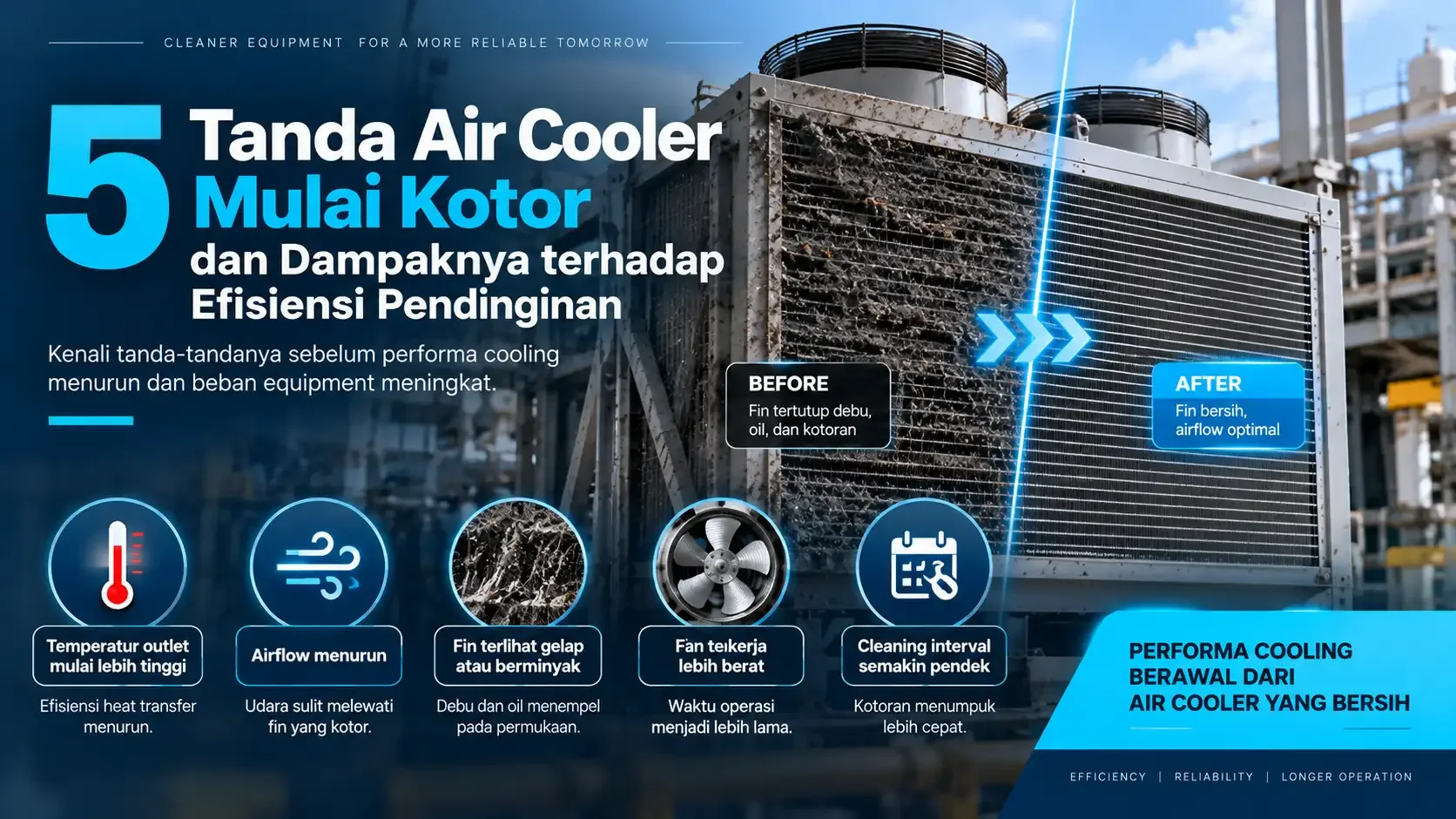
A dirty air cooler can gradually reduce airflow and heat-transfer performance. Learn five signs of fouling and how contamination may affect cooling efficiency.

Article Summary18 sections
Industrial air coolers depend on sufficient airflow and effective heat transfer across the fin and tube surfaces. Over time, dust, oil mist, grease, and process contamination can gradually accumulate on these surfaces.
The effect may not be immediately obvious, but increasing fouling can restrict airflow and reduce heat-transfer performance.
Recognizing the early signs that an air cooler needs cleaning can help maintenance teams respond before cooling performance deteriorates further.
Why Air Cooler Cleanliness Matters
Heat transfer depends on air moving freely across the heat-exchanger surface. Dust and oily deposits can create additional resistance between the air and the metal surface.
1. Outlet Temperature Begins to Increase
If process load remains relatively stable while outlet temperature starts to rise, the condition of the air cooler should be investigated.
Fouling is only one possible cause, so ambient temperature, airflow, fan condition, and process changes should also be considered.
2. Airflow Decreases
Contaminated fins can increase resistance to airflow. As blockage develops, less air may pass through the heat exchanger.
Airflow data or differential pressure can be useful where available, while visual inspection remains valuable for equipment without dedicated monitoring.
3. Fins Become Dark, Oily, or Dusty
Visual contamination is one of the easiest signs to identify. Oil mist can be particularly problematic because it creates a sticky surface that traps airborne dust.
When oily fouling develops, dry cleaning alone may no longer be sufficient.
4. The Fan Operates Longer or Harder
When heat-transfer performance decreases, the cooling system may require more operating time to maintain the same temperature target.
Fan condition should also be inspected separately, including blades, bearings, vibration, alignment, and motor condition.
5. Cleaning Is Required More Frequently
If the air cooler becomes contaminated faster than historical trends, the source of contamination should also be investigated.
Oil leakage, dust generation, exhaust, or changes in the operating environment may increase the fouling rate.
How Fouling Affects Cooling Efficiency
Air cooler fouling may reduce heat transfer, restrict airflow, increase fan operating time, and lead to more frequent maintenance.
The actual impact depends on exchanger design, contamination type, blockage severity, and operating conditions.
When Should an Air Cooler Be Cleaned?
There is no universal cleaning interval. Cleaning decisions should consider actual equipment condition, temperature trends, airflow, visible fouling, maintenance history, and manufacturer recommendations.
Condition-based maintenance can often provide a better basis than relying only on a fixed calendar interval.
Air Cooler Cleaning Methods
- Dry cleaning: for loose dust and light contamination.
- Compressed air: used with controlled pressure and direction.
- Water cleaning: used within the equipment pressure limits.
- Chemical cleaning: considered for oil, grease, and selected deposits.
Selecting an Air Cooler Cleaner
Chemical selection should consider the deposit and the materials used in the air cooler.
Fin material may include aluminium or other metals, making compatibility an important consideration.
Always review concentration, contact time, rinsing requirements, TDS, and SDS before application.
Industrial Air Cooler Cleaning Solutions
For oil, grease, and dirt that cannot be effectively removed with routine dry cleaning, an industrial air cooler cleaner may be considered.
Yume Global Indonesia provides solutions including NEO Air Cooler Cleaner and Synestra Air Cooler Cleaner for industrial maintenance applications.
Conclusion
Air cooler contamination can gradually reduce performance before an obvious failure occurs.
Rising outlet temperature, reduced airflow, visible fin contamination, longer fan operation, and increasingly frequent cleaning are useful signs to monitor.
Routine inspection, performance trending, and condition-based cleaning can help maintain more consistent airflow and heat-transfer performance.
Frequently Asked Questions
Does light dust always mean the air cooler should be cleaned?
Not necessarily. Consider fouling severity, temperature trends, airflow, and overall equipment condition.
Why is oil mist a problem for air coolers?
Oil mist can create a sticky surface that captures dust, allowing fouling to develop more quickly.
Is high-pressure water safe for air cooler fins?
Excessive pressure may bend the fins. Follow the equipment manufacturer's recommended pressure and cleaning method.
Are all air cooler cleaners safe for aluminium?
No. Material compatibility varies by product. Review the TDS before use.
How often should an industrial air cooler be cleaned?
There is no universal interval. Cleaning frequency should reflect the operating environment, fouling rate, maintenance history, and actual performance trends.
Published: September 21, 2026