
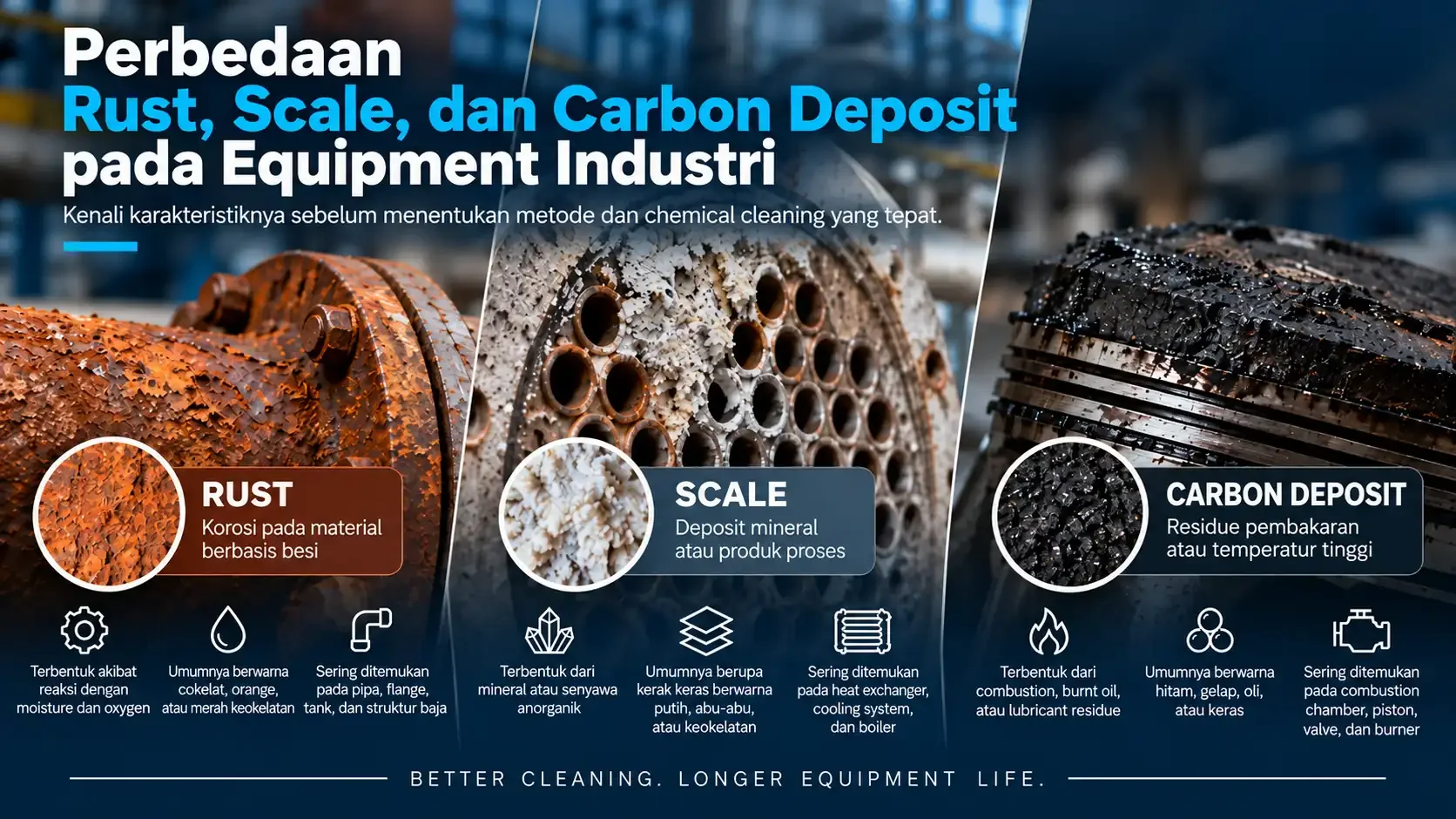
Rust, scale, and carbon deposits may look similar but form through different processes. Learn how to identify them before selecting an industrial cleaning method.

Article Summary21 sections
Not every deposit found on industrial equipment can be removed using the same cleaning method or chemical. Brown, black, or hardened deposits may result from completely different processes.
Three common conditions are rust, scale, and carbon deposits. Although they may all appear as unwanted buildup, their causes, characteristics, and cleaning requirements are different.
Understanding the difference between rust vs scale vs carbon deposits helps maintenance teams select a more appropriate inspection, surface preparation, and cleaning strategy.
Rust vs Scale vs Carbon Deposits
| Deposit | Common Cause | Typical Appearance |
|---|---|---|
| Rust | Corrosion of iron-based materials exposed to moisture and oxygen. | Brown, orange, reddish-brown, flaky or crusted. |
| Scale | Minerals, process products, or inorganic material deposited on a surface. | Hard, white, grey, brown, or layered deposits. |
| Carbon Deposit | Combustion residue, burnt oil, lubricant residue, or high-temperature exposure. | Black, dark, oily, hardened, or burnt-on. |
What Is Rust?
Rust is a corrosion product commonly formed when iron or carbon steel reacts with oxygen and moisture.
It may range from light surface discoloration to heavy flaky corrosion and pitting.
Rust is commonly found on piping, flanges, steel structures, tanks, machinery components, and equipment exposed to humid or wet environments.
What Is Scale?
Scale is a general term for hard deposits formed by minerals, process compounds, or inorganic material accumulating on a surface.
Mineral scale is frequently associated with equipment exposed to water, although actual composition depends on the process and fluid involved.
It may occur in heat exchangers, cooling systems, piping, tanks, and other process equipment.
What Is a Carbon Deposit?
Carbon deposits are residues associated with combustion, burnt fuel, lubricants, or organic material exposed to high temperatures.
They may appear as black soot, oily residue, or hard burnt-on deposits strongly attached to the component surface.
Typical locations include combustion chambers, pistons, valves, selected injector components, burners, and exhaust-related equipment.
Why Deposit Identification Matters
Cleaning chemicals are generally formulated for particular types of contamination. A degreaser may not remove corrosion, while a rust remover may not be suitable for hardened carbon deposits.
Incorrect identification can result in:
- Longer cleaning time.
- Excessive chemical consumption.
- Unnecessary increases in concentration or contact time.
- Greater material compatibility risk.
- Incomplete cleaning.
- Repeated maintenance work.
How to Identify the Deposit
Check the Location
Deposit location can help indicate its source. Black buildup inside combustion-related equipment is different from white deposits found in many water systems.
Review Operating Conditions
Determine whether the equipment is exposed to combustion, process water, lubricants, chemicals, or humid environments.
Check Deposit Texture
Deposits may be powdery, flaky, oily, sticky, hard, or burnt-on. These characteristics can help narrow down the contamination type.
Review Maintenance History
Equipment operating and cleaning history can provide useful information. Repeated deposit formation may indicate an underlying process condition that has not been addressed.
Selecting a Cleaning Method
| Deposit | Possible Approach |
|---|---|
| Oil & Grease | Degreasing with a compatible cleaner. |
| Rust | Mechanical preparation and/or suitable rust removal treatment. |
| Carbon Deposit | Carbon remover and mechanical cleaning where appropriate. |
| Scale | Cleaning method based on scale composition and equipment material. |
What If Several Deposits Are Present?
Industrial components frequently contain more than one type of contamination. Oil and grease may cover carbon deposits, or corrosion may be hidden beneath oily dirt.
A staged process may therefore be appropriate:
- Identify the different contaminants.
- Remove loose dirt and deposits.
- Degrease when oil or grease is present.
- Treat the remaining rust, carbon, or scale using an appropriate method.
- Rinse where required.
- Dry and perform final inspection.
Common Mistakes to Avoid
- Selecting chemicals only by deposit color.
- Using one cleaner for every type of contamination.
- Ignoring material compatibility.
- Increasing concentration without following the TDS.
- Exceeding recommended contact time.
- Mixing chemicals without manufacturer approval.
- Skipping post-cleaning inspection.
Industrial Cleaning Solutions for Different Deposits
Yume Global Indonesia provides industrial cleaning solutions for maintenance applications.
Available options include degreasing solutions for oil and grease, carbon removers for combustion deposits, and rust removers for selected corrosion applications.
Product selection should always consider deposit type, equipment material, application method, TDS, and SDS requirements.
Conclusion
Rust, scale, and carbon deposits form through different mechanisms and should not automatically be treated using the same cleaning approach.
Rust is associated with corrosion of iron-based materials, scale commonly consists of mineral or process deposits, while carbon buildup is frequently associated with combustion and high-temperature operation.
Correctly identifying the deposit before selecting a cleaner helps maintenance teams choose a more suitable process, reduce unnecessary chemical consumption, and better protect equipment materials.
Frequently Asked Questions
Is every brown deposit rust?
No. Color is only an initial indicator. Mineral scale and other contamination may also appear brown or grey.
Can scale always be removed with a rust remover?
No. Scale composition varies, so the cleaning method should be selected according to the deposit and equipment material.
What is the difference between carbon deposits and grease?
Grease is primarily an oily lubricant contamination, while carbon deposits are commonly associated with combustion, burnt oil, or high-temperature exposure.
Can one component contain several types of deposits?
Yes. Oil, grease, rust, carbon, dirt, and scale may occur together, requiring a staged cleaning process.
What should be checked before choosing a chemical cleaner?
Review the deposit type, equipment material, operating conditions, application method, concentration, contact time, rinsing requirements, TDS, and SDS.
Published: September 22, 2026