
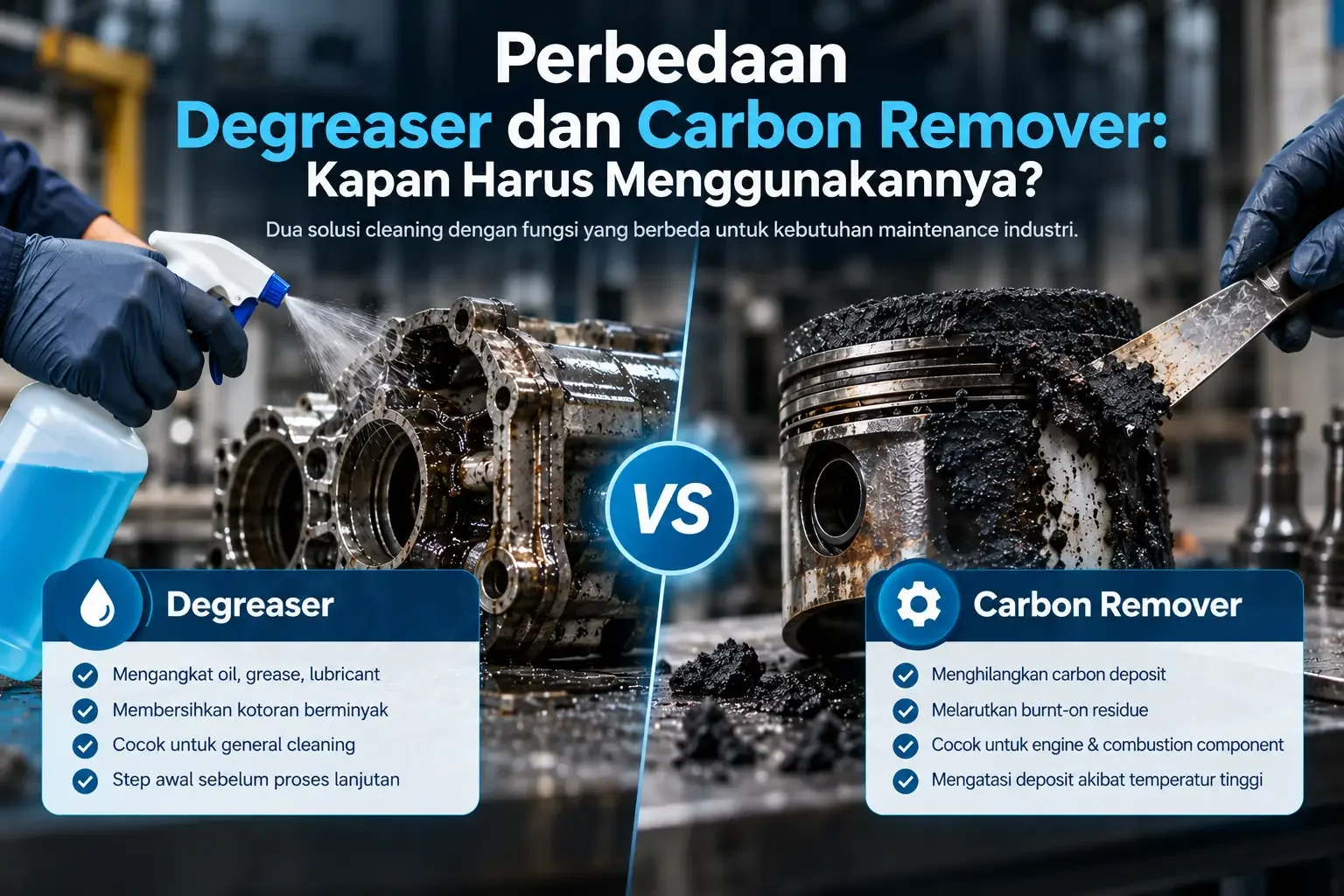
Degreasers and carbon removers serve different purposes in industrial cleaning. Learn which contaminants each cleaner targets and when to use them.

Article Summary15 sections
Selecting an industrial cleaning chemical should not be based solely on cleaning strength. The type of contamination being removed is one of the most important factors in determining the appropriate product.
Two cleaners commonly used in industrial maintenance are degreasers and carbon removers. Although both are used for cleaning, they target different types of contamination and are intended for different applications.
What Is a Degreaser?
A degreaser is a cleaning chemical designed to remove oil, grease, lubricant residue, hydrocarbon contamination, and oily dirt from equipment and component surfaces.
Degreasing is commonly performed before inspection, repair, rust removal, painting, coating, or another cleaning process.
What Is a Carbon Remover?
A carbon remover is formulated to loosen, dissolve, or remove carbon deposits and combustion residues that may become strongly attached to equipment surfaces.
Typical applications include engines, pistons, valves, selected fuel-system components, burners, and equipment exposed to carbon buildup.
Degreaser vs Carbon Remover
| Aspect | Degreaser | Carbon Remover |
|---|---|---|
| Main target | Oil, grease and lubricant residue. | Carbon deposits, burnt residue and selected varnish. |
| Typical contamination | Oily or greasy deposits. | Heat-related or combustion deposits. |
| Common applications | Machinery, parts and surface preparation. | Engine and combustion-related components. |
When Should a Degreaser Be Used?
Use a degreaser when the primary contamination consists of oil, grease, lubricant residue, or oily dirt.
- Machinery and equipment cleaning.
- Removing lubricant residue before inspection.
- Surface preparation before rust removal.
- Workshop component cleaning.
- Preparation before painting or coating.
When Should a Carbon Remover Be Used?
A carbon remover is more appropriate when contamination results from combustion, carbonization, or exposure to elevated temperatures.
- Pistons and piston crowns.
- Valves and combustion components.
- Selected injector components.
- Engine components with carbon buildup.
- Burners and combustion-related equipment.
Can a Degreaser Replace a Carbon Remover?
Not necessarily. A degreaser may remove oily contamination covering a carbon deposit, but it may not effectively remove hardened carbon that has formed under high-temperature conditions.
Likewise, using a carbon remover for simple oil or grease contamination may not be the most efficient cleaning approach.
Can Both Products Be Used in the Same Cleaning Process?
Yes, depending on the contamination. For example, a component covered by both grease and hardened carbon may first be degreased before the remaining carbon deposit is treated.
- Inspect and identify the contamination.
- Remove oil and grease with a suitable degreaser.
- Rinse or prepare the component according to the product instructions.
- Apply the appropriate carbon remover.
- Observe the recommended contact time.
- Rinse or clean the component as required.
- Inspect the surface after cleaning.
How to Select the Right Cleaning Chemical
Consider the contamination type, component material, application method, contact time, rinsing requirements, and safety procedures before selecting a cleaner.
Yume Global Indonesia provides industrial cleaning solutions including Chromax Heavy Duty Degreaser Multipurpose, Chromax Carbon Remover, Synestra Carbon Remover, and NEO Carbon Remover CR-704.
Product selection should be based on the actual deposit, material compatibility, and the recommended application procedure.
Conclusion
Degreasers and carbon removers perform different roles. Degreasers primarily target oil, grease, and oily contamination, while carbon removers are intended for carbon buildup and selected combustion-related residues.
In some maintenance applications, both products may be used sequentially. However, each chemical must still be applied according to its technical instructions and should never be mixed without manufacturer approval.
Correctly identifying the contamination before choosing a cleaner can make industrial cleaning safer, more efficient, and more effective.
Frequently Asked Questions
What is the main difference between a degreaser and a carbon remover?
A degreaser primarily removes oil and grease, while a carbon remover is designed for carbon buildup and combustion residues.
Can a degreaser remove carbon deposits?
It may remove oil mixed with the carbon, but it may not effectively remove hardened carbon deposits.
Should degreasing be performed before carbon removal?
Not in every application. However, degreasing can be useful when oil or grease covers the carbon deposit.
Can a degreaser and carbon remover be mixed?
Do not mix cleaning chemicals unless explicitly permitted by the manufacturer. Always review the TDS and SDS.
How should an industrial cleaner be selected?
Identify the contamination, component material, cleaning method, operating conditions, and safety requirements before selecting a product.
Published: September 16, 2026