
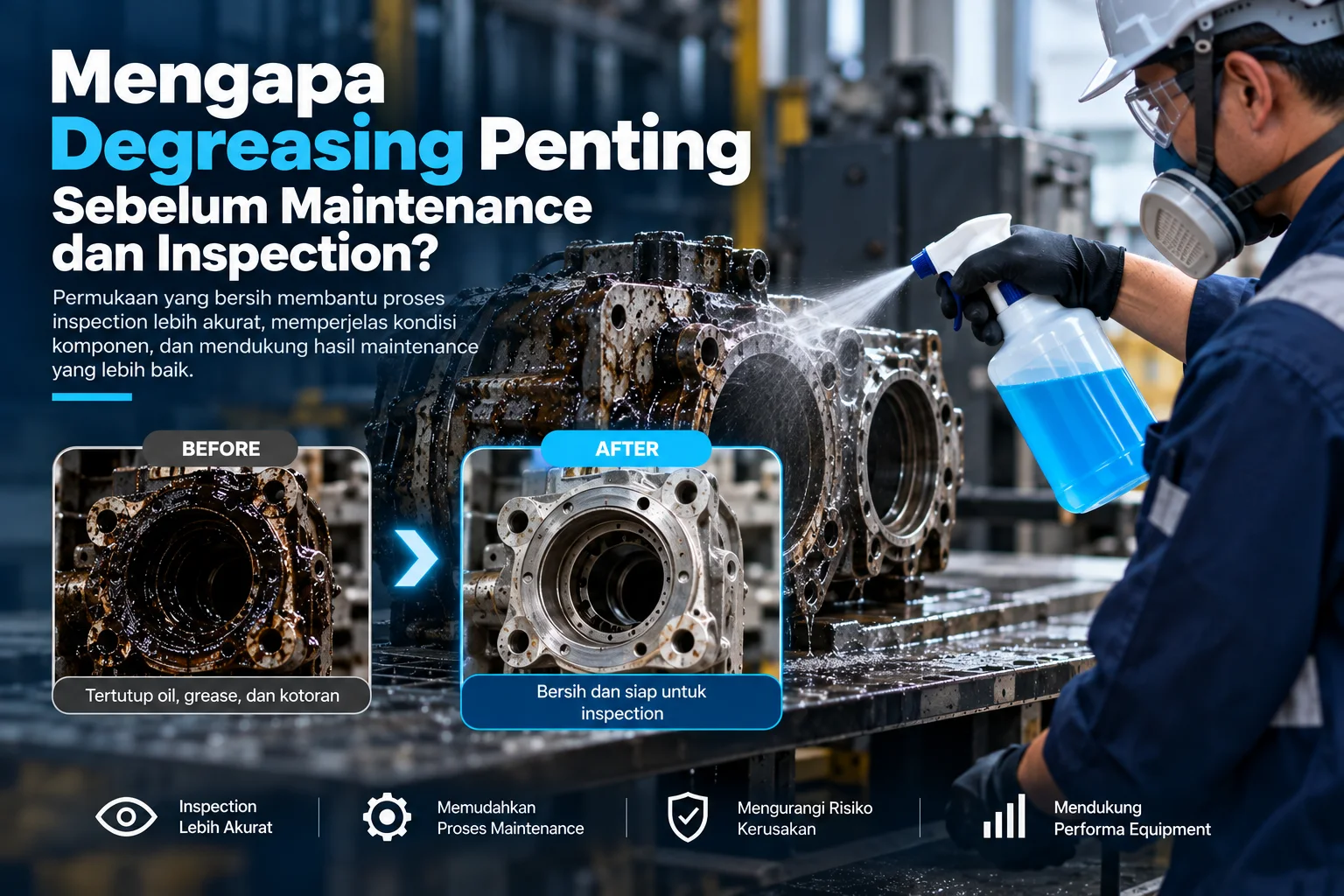
Oil, grease, and contamination can hide the true condition of industrial components. Learn why degreasing is an important step before inspection, repair, and maintenance.

Article Summary19 sections
Before a component is inspected, repaired, painted, or subjected to another maintenance process, its surface should be clean enough for technicians to evaluate its actual condition.
Oil, grease, lubricant residue, dirt, and process contamination can hide corrosion, wear, leakage, cracks, and other surface conditions. For this reason, degreasing before maintenance is an important preparation step in many industrial applications.
Degreasing is not simply about making equipment look clean. It helps prepare surfaces for inspection, repair, rust removal, painting, coating, disassembly, and other maintenance activities.
What Is Degreasing?
Degreasing is the process of removing oil, grease, lubricant residue, and other oil-based contamination from a surface.
Depending on the equipment and contamination, the process may involve spraying, wiping, brushing, soaking, immersion, or circulation cleaning.
Why Is Degreasing Important Before Inspection?
Inspection requires sufficient access to the actual component surface. Heavy grease, oil, and dirt can hide conditions that maintenance personnel need to identify.
| Condition | Effect of Contamination | Benefit of Degreasing |
|---|---|---|
| Corrosion | Oil and dirt can hide rust and pitting. | The substrate becomes easier to inspect. |
| Cracks | Contamination may conceal visible indications. | The inspection area becomes clearer. |
| Leakage | Old oil may make active leaks harder to identify. | Post-cleaning monitoring becomes easier. |
| Wear | Grease and sludge may cover surface wear. | Wear patterns become more visible. |
1. Reveals the Actual Surface Condition
A dirty component is not necessarily a healthy component. Oil and grease may hide corrosion, pitting, scoring, overheating marks, or other surface damage.
After degreasing, technicians can perform visual inspection with better access to the actual surface.
2. Helps Identify the Source of Leaks
Equipment affected by oil leakage may already be covered with old oil residue. Without cleaning, it can be difficult to distinguish historical contamination from an active leak.
After degreasing, the area can be monitored again, making newly appearing oil easier to trace.
3. Prepares the Surface for Rust Removal
Oil and grease can form a barrier between a rust remover and the corrosion underneath. Degreasing is therefore often an important preparation step before rust removal.
4. Supports Painting and Coating Preparation
Oil and grease contamination may interfere with coating adhesion. Surface preparation commonly includes appropriate cleaning before paint or protective coating is applied.
The complete process should follow the coating manufacturer's requirements.
5. Reduces Contamination During Disassembly
Heavily contaminated equipment can transfer oil and grease to tools, workbenches, operators, and nearby components during disassembly.
Pre-cleaning can help keep maintenance work more controlled and reduce the spread of contamination.
6. Supports Further Cleaning Processes
A component may contain more than one type of deposit. For example, hardened carbon may be covered by oil and grease.
In this situation, degreasing first may allow a carbon remover to reach the underlying carbon deposit more effectively.
When Should Degreasing Be Performed?
- Before visual inspection.
- Before equipment disassembly.
- Before leakage inspection.
- Before rust removal.
- Before mechanical repair.
- Before painting or coating.
- Before selected carbon cleaning processes.
- During component overhaul.
- Before selected non-destructive testing processes according to applicable procedures.
Common Degreasing Mistakes
- Using a degreaser without checking material compatibility.
- Using a concentration above the recommended range.
- Exceeding the recommended contact time.
- Skipping rinsing when it is required.
- Ignoring seals, coatings, or other sensitive materials.
- Using inadequate PPE.
- Mixing chemicals without manufacturer approval.
How to Select an Industrial Degreaser
Cleaner selection should be based on the actual maintenance application rather than cleaning strength alone.
| Consideration | What to Check |
|---|---|
| Contamination | Oil, grease, lubricant, sludge, or oily dirt. |
| Material | Metal, coatings, plastics, rubber, seals, and other materials. |
| Application | Spraying, wiping, brushing, immersion, or circulation. |
| Dilution | Follow the concentration stated in the product TDS. |
| Safety | Review the SDS, PPE, ventilation, handling, and disposal requirements. |
Industrial Degreasing Solutions for Maintenance
For oil, grease, lubricant residue, and other oily contamination, an industrial degreaser may be used according to the equipment material and cleaning requirements.
Yume Global Indonesia provides Chromax Heavy Duty Degreaser Multipurpose for industrial cleaning applications.
Application method, concentration, contact time, and rinsing requirements should always follow the Technical Data Sheet, Safety Data Sheet, and actual equipment conditions.
Conclusion
Degreasing is an important preparation step for many maintenance and inspection activities. Oil and grease can prevent technicians from clearly seeing the true condition of a component.
Proper degreasing can prepare equipment for inspection, leak monitoring, disassembly, rust removal, repair, painting, coating, and further cleaning.
However, the cleaning product should always be selected according to the contamination, material compatibility, application method, concentration, contact time, and safety requirements.
Frequently Asked Questions
Is degreasing always required before maintenance?
Not for every maintenance activity. However, it is particularly useful when oil, grease, or contamination prevents proper inspection or further maintenance work.
What is the difference between degreasing and general cleaning?
Degreasing specifically targets oil, grease, lubricant residue, and oily contamination, while general cleaning may cover many other types of dirt and deposits.
Can a degreaser remove carbon deposits?
A degreaser may remove oily contamination associated with carbon, but hardened carbon deposits may require a dedicated carbon remover.
Why is degreasing important before rust removal?
Oil and grease can block direct contact between a rust remover and corrosion deposits, so oily contamination should generally be removed first.
What should be checked before using an industrial degreaser?
Check the contamination type, material compatibility, dilution ratio, contact time, application method, rinsing requirements, TDS, and SDS.
Published: September 16, 2026