
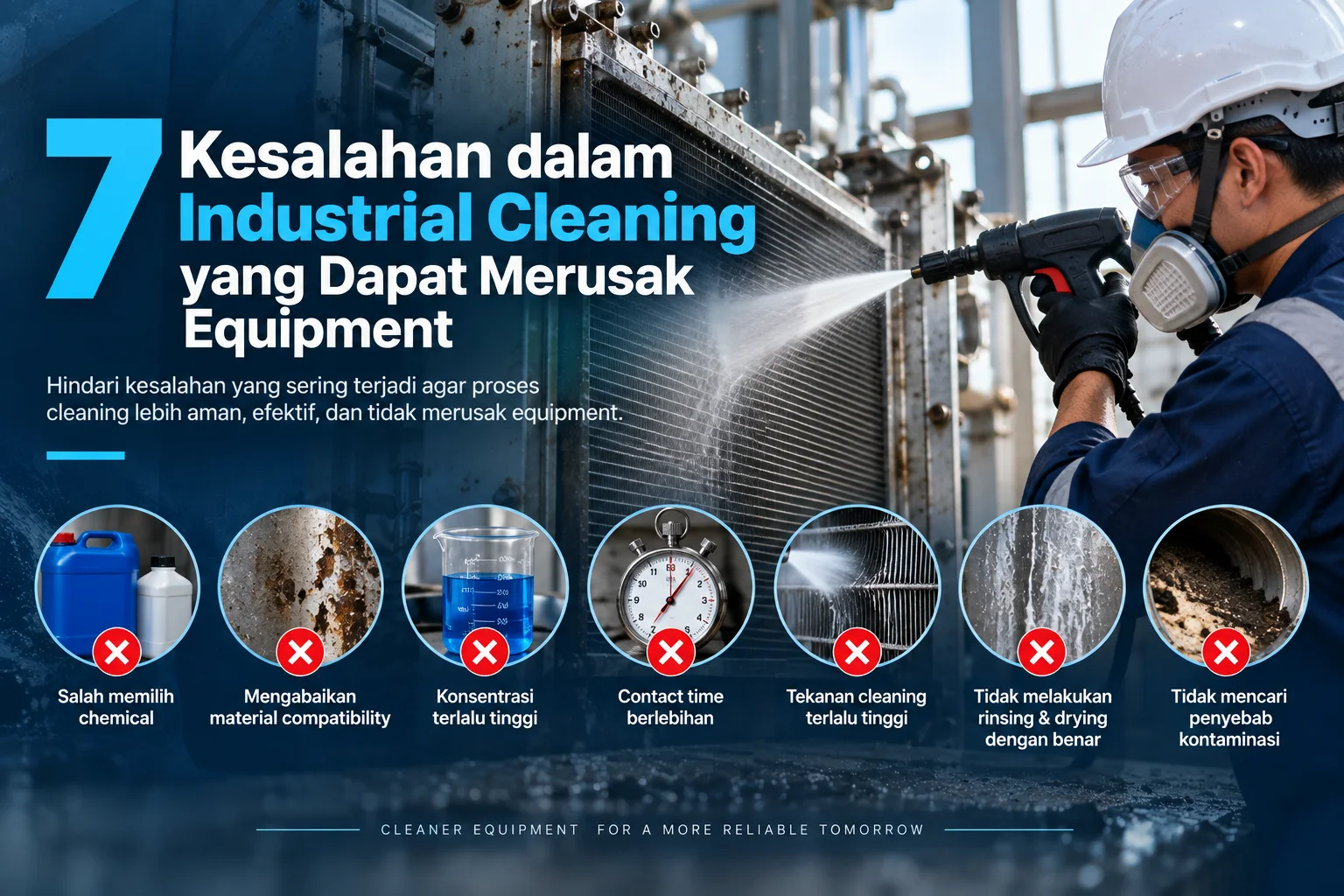
Incorrect chemical selection, concentration, contact time, and cleaning methods can damage industrial equipment. Learn seven common mistakes to avoid during industrial cleaning.

Article Summary18 sections
Industrial cleaning plays an important role in maintenance because it helps remove contamination, supports equipment inspection, and contributes to more reliable operation. However, cleaning performed with the wrong method or chemical can create new problems instead of solving them.
Coating damage, corrosion, material discoloration, damaged seals, bent fins, and residual chemicals are some of the issues that may occur when the cleaning process is not matched to the equipment condition.
For this reason, understanding common industrial cleaning mistakes is just as important as choosing the right cleaning product.
Why Industrial Cleaning Must Be Carefully Controlled
Industrial cleaning is different from ordinary housekeeping. Industrial equipment may consist of carbon steel, stainless steel, aluminium, copper, coatings, rubber seals, gaskets, plastics, and many other materials.
A method that works safely on one surface may cause problems on another. The cleaning process should therefore begin by identifying the deposit and equipment condition rather than immediately selecting the strongest available chemical.
| Factor | What to Check |
|---|---|
| Deposit | Oil, grease, carbon, rust, scale, dirt, or mixed contamination. |
| Material | Metal, coatings, seals, gaskets, plastics, and other sensitive materials. |
| Method | Spraying, brushing, soaking, circulation, pressure cleaning, or mechanical cleaning. |
| Parameters | Concentration, contact time, temperature, rinsing, drying, and disposal. |
1. Using the Wrong Chemical for the Deposit
One of the most common mistakes is choosing a cleaner based only on perceived cleaning strength. Different chemicals are designed for different types of contamination.
A degreaser is generally intended for oil and grease, a carbon remover is used for carbon deposits, and a rust remover is designed for selected corrosion deposits.
Using the wrong product can make cleaning less effective, increase cleaning time, and encourage operators to use excessive concentrations.
2. Ignoring Material Compatibility
Cleaning chemicals can react differently with aluminium, carbon steel, stainless steel, copper, coatings, seals, and other materials.
Before application, always review the Technical Data Sheet (TDS), Safety Data Sheet (SDS), and manufacturer recommendations.
3. Using a Higher Concentration Than Recommended
A stronger solution does not always mean faster or better cleaning. Excessive concentration can increase the risk of material damage, make rinsing more difficult, and increase chemical consumption.
Use the dilution ratio stated in the TDS. Only adjust concentration within the range recommended by the product manufacturer.
4. Leaving the Chemical on the Surface Too Long
Every cleaner has a recommended contact time. Leaving the chemical on the surface longer than recommended does not automatically improve cleaning performance.
Excessive exposure may affect the substrate, coating, seal, or surrounding components.
5. Using Excessive Cleaning Pressure
High-pressure water and compressed air can be useful during cleaning, but excessive pressure can cause physical damage.
For example, thin fins on air coolers or heat exchangers can bend if pressure is too high or the nozzle is placed too close to the surface.
Always consider pressure, nozzle distance, cleaning direction, and the equipment manufacturer's recommendations.
6. Poor Rinsing and Drying
Some cleaning chemicals require rinsing after application. If chemical residue remains on the surface, it may affect the material or interfere with later processes such as coating, painting, inspection, or assembly.
Drying is equally important. Metal surfaces that remain wet may be more susceptible to flash rust or new contamination.
7. Failing to Investigate the Root Cause of Contamination
Cleaning removes existing contamination, but it does not automatically eliminate the source of the problem.
Recurring carbon deposits may be linked to combustion conditions, while repeated oil contamination may result from leakage, seal problems, or another mechanical issue.
If contamination returns frequently, the maintenance team should investigate the root cause instead of repeatedly cleaning the same symptom.
Summary of the 7 Industrial Cleaning Mistakes
| Mistake | Potential Risk | Prevention |
|---|---|---|
| Wrong chemical selection | Ineffective cleaning. | Identify the deposit first. |
| Ignoring compatibility | Material or coating may be affected. | Review the TDS and perform a test spot. |
| Excessive concentration | Higher material risk and chemical waste. | Follow the recommended dilution ratio. |
| Excessive contact time | Unnecessary surface exposure. | Follow the recommended contact time. |
| Excessive pressure | Damage to fins or sensitive components. | Control pressure, nozzle distance, and direction. |
| Poor rinsing and drying | Chemical residue or flash rust. | Follow the correct post-cleaning procedure. |
| No root-cause analysis | Contamination returns quickly. | Investigate the source of the deposit. |
How to Perform Industrial Cleaning More Safely
- Identify the type of deposit and the equipment condition.
- Identify all materials that may come into contact with the cleaner.
- Select the appropriate cleaning chemical.
- Review the TDS and SDS before starting the work.
- Use the recommended concentration and contact time.
- Use appropriate PPE and equipment isolation procedures.
- Perform a test spot when compatibility is uncertain.
- Rinse and dry according to the product instructions.
- Carry out a final inspection after cleaning.
- Investigate recurring contamination through root-cause analysis.
Selecting the Right Industrial Cleaning Solution
The type of cleaner should match the type of contamination present. For oil and grease, an industrial degreaser may be suitable.
Combustion-related deposits may require a carbon remover, while selected corrosion deposits may require a rust remover. Air coolers and heat exchangers may also require cleaners that are compatible with their fin and tube materials.
Using this approach allows the cleaning process to be more targeted than relying on one chemical for every type of contamination.
Conclusion
Effective industrial cleaning is not simply about using the strongest available chemical. Good results come from selecting the right cleaner, confirming material compatibility, controlling concentration and contact time, using the correct application method, and completing the necessary rinsing, drying, and inspection.
Avoiding these seven common mistakes can help reduce the risk of equipment damage and make maintenance activities more controlled and effective.
When contamination continues to return after cleaning, the underlying cause should also be investigated so that maintenance addresses the source of the problem rather than only the visible deposit.
Frequently Asked Questions
Does a stronger chemical always provide better cleaning?
No. The cleaner should match the deposit, material, and application conditions. An unnecessarily aggressive chemical may increase the risk of equipment damage.
Are all industrial cleaners safe for aluminium?
No. Material compatibility varies by product. Always review the TDS and manufacturer recommendations before use.
Why is contact time important?
Contact time determines how long the chemical interacts with both the deposit and the material. Longer exposure does not automatically improve cleaning performance.
Does equipment always need to be rinsed after chemical cleaning?
It depends on the product. If the TDS requires rinsing, the recommended procedure should be followed.
Why does contamination return after cleaning?
The original source of contamination may still be present, such as leakage, combustion problems, or specific operating conditions. Recurring deposits should be investigated through root-cause analysis.
Published: September 16, 2026