
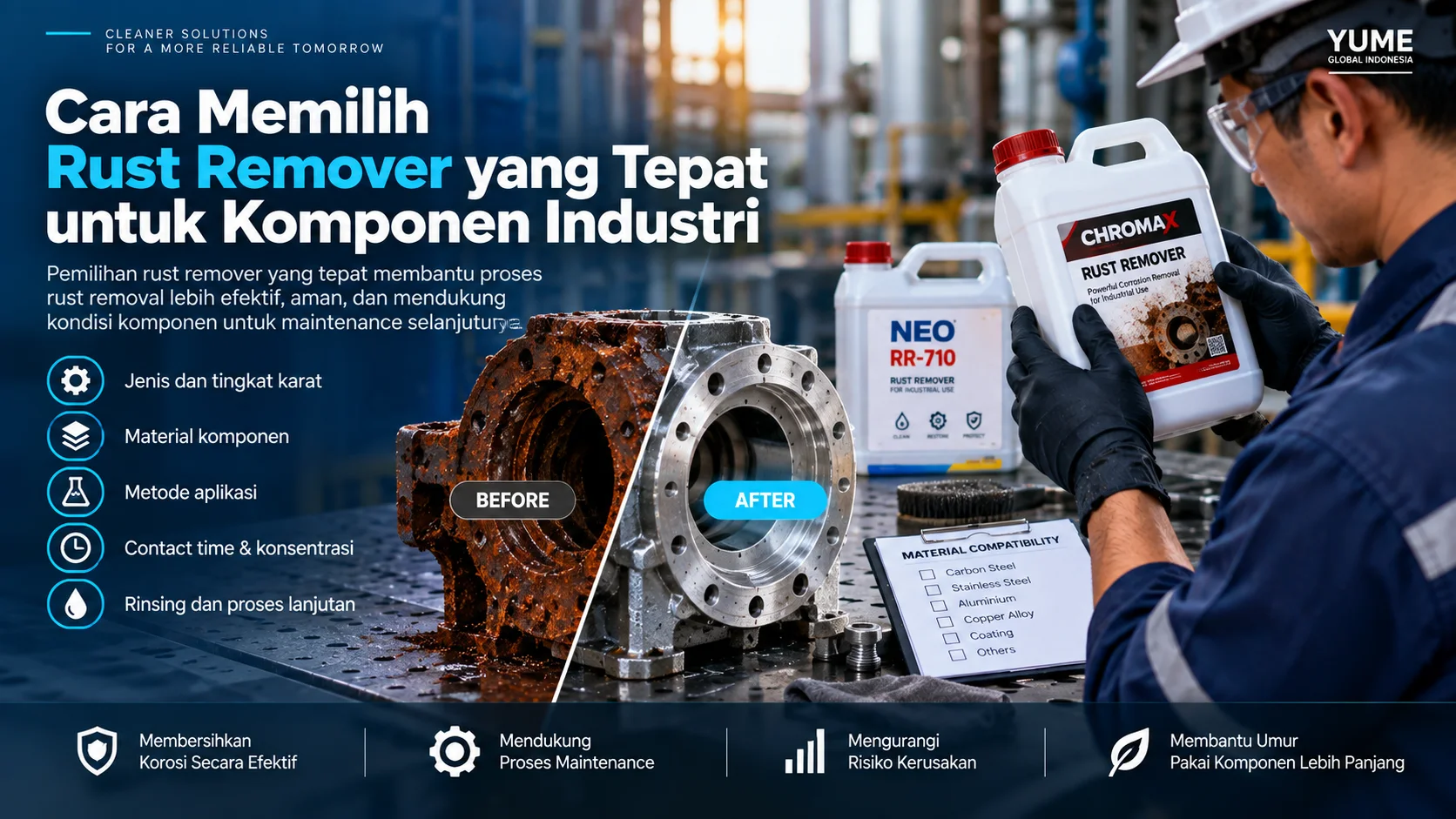
Choosing an industrial rust remover requires more than cleaning strength. Learn how corrosion severity, material compatibility, application method, contact time, and post-cleaning treatment affect product selection.

Article Summary17 sections
Rust is one of the most common forms of corrosion found on iron-based and carbon-steel components. During maintenance, corrosion deposits may need to be removed to expose the actual surface, support inspection, and prepare components for repair or coating.
However, selecting an industrial rust remover should involve more than choosing the strongest available chemical. Material compatibility, corrosion severity, application method, contact time, rinsing, and post-cleaning requirements must also be considered.
Why Does Rust Remover Selection Matter?
Rust removers interact chemically with corrosion deposits. Because product formulations and application requirements differ, cleaning performance depends heavily on the condition of the surface and material.
An unsuitable product may result in ineffective cleaning, longer contact time, excessive chemical consumption, or unwanted effects on the component surface.
1. Identify the Severity of Corrosion
Light surface rust requires a different approach from heavy corrosion, thick scale, or surfaces affected by pitting.
Before selecting a cleaner, inspect the affected area, deposit thickness, loose scale, and general component condition.
For heavy corrosion, preliminary mechanical cleaning may help remove loose deposits before chemical treatment.
2. Identify the Component Material
Material compatibility is critical. A chemical suitable for carbon steel may not be appropriate for aluminium, copper alloys, coated surfaces, seals, or other materials.
Always review the Technical Data Sheet (TDS), Safety Data Sheet (SDS), and manufacturer recommendations.
3. Remove Oil and Grease First
Rust remover must be able to reach the corrosion deposit. Oil, grease, and lubricant residue can create a barrier on the surface.
When oily contamination is present, degreasing should generally be performed before rust removal.
4. Select the Appropriate Application Method
- Brushing: suitable for localized accessible areas.
- Spraying: useful for selected surface applications where permitted.
- Soaking: suitable for smaller components.
- Immersion: applicable to tank cleaning when permitted by the product instructions.
- Circulation: may be suitable for specific systems and procedures.
Not every rust remover is designed for every application method, so product instructions should always be followed.
5. Control Concentration and Contact Time
A stronger solution or longer exposure does not automatically provide better cleaning. Use the recommended concentration and contact time stated in the product TDS.
Monitor the surface during cleaning and avoid unnecessary exposure.
6. Check Rinsing and Neutralization Requirements
Some rust removers require rinsing after application. Others may have specific neutralization or post-treatment requirements.
These steps are important because chemical residue can interfere with coating, painting, assembly, or other processes.
7. Consider the Risk of Flash Rust
Once rust has been removed, bare metal may be directly exposed to moisture and oxygen.
In humid environments, a thin layer of corrosion known as flash rust may form relatively quickly.
Proper drying and timely protective treatment, coating, or preservation can help reduce this risk.
Rust Remover Selection Checklist
| Question | Checked? |
|---|---|
| Has the corrosion severity been identified? | ✓ |
| Has the base material been confirmed? | ✓ |
| Have oil and grease been removed? | ✓ |
| Has chemical compatibility been confirmed? | ✓ |
| Are concentration and contact time known? | ✓ |
| Have rinsing and drying requirements been reviewed? | ✓ |
Industrial Rust Removal Solutions
For corrosion-cleaning applications, an industrial rust remover may be selected according to deposit severity, material compatibility, and application requirements.
Yume Global Indonesia provides rust removal solutions including Chromax Rust Remover and NEO Rust Remover RR-710.
Product selection and application should follow the TDS, SDS, and actual equipment conditions.
Conclusion
Selecting the right rust remover requires more than choosing the strongest cleaning chemical.
Corrosion type, component material, surface condition, application method, concentration, contact time, rinsing, drying, and post-cleaning protection should all be considered together.
A properly selected rust-removal process can help prepare components for inspection, repair, coating, and further maintenance while reducing unnecessary risk to the substrate.
Frequently Asked Questions
Are all rust removers safe for every metal?
No. Compatibility varies between chemicals and materials. Always review the TDS, SDS, and manufacturer recommendations.
Should heavy rust be removed mechanically first?
Loose rust and heavy scale may be reduced mechanically so the cleaner can reach corrosion that remains attached to the substrate.
Why is degreasing important before rust removal?
Oil and grease can prevent direct contact between the cleaner and corrosion deposit.
Does longer contact time improve rust removal?
Not necessarily. Follow the recommended contact time to avoid unnecessary chemical exposure.
Why can rust return after cleaning?
Bare metal can react again with moisture and oxygen. Proper drying and post-cleaning protection can reduce the risk of flash rust.
Published: September 16, 2026